M-air enters strategic agreement to accelerate development of low-altitude economy
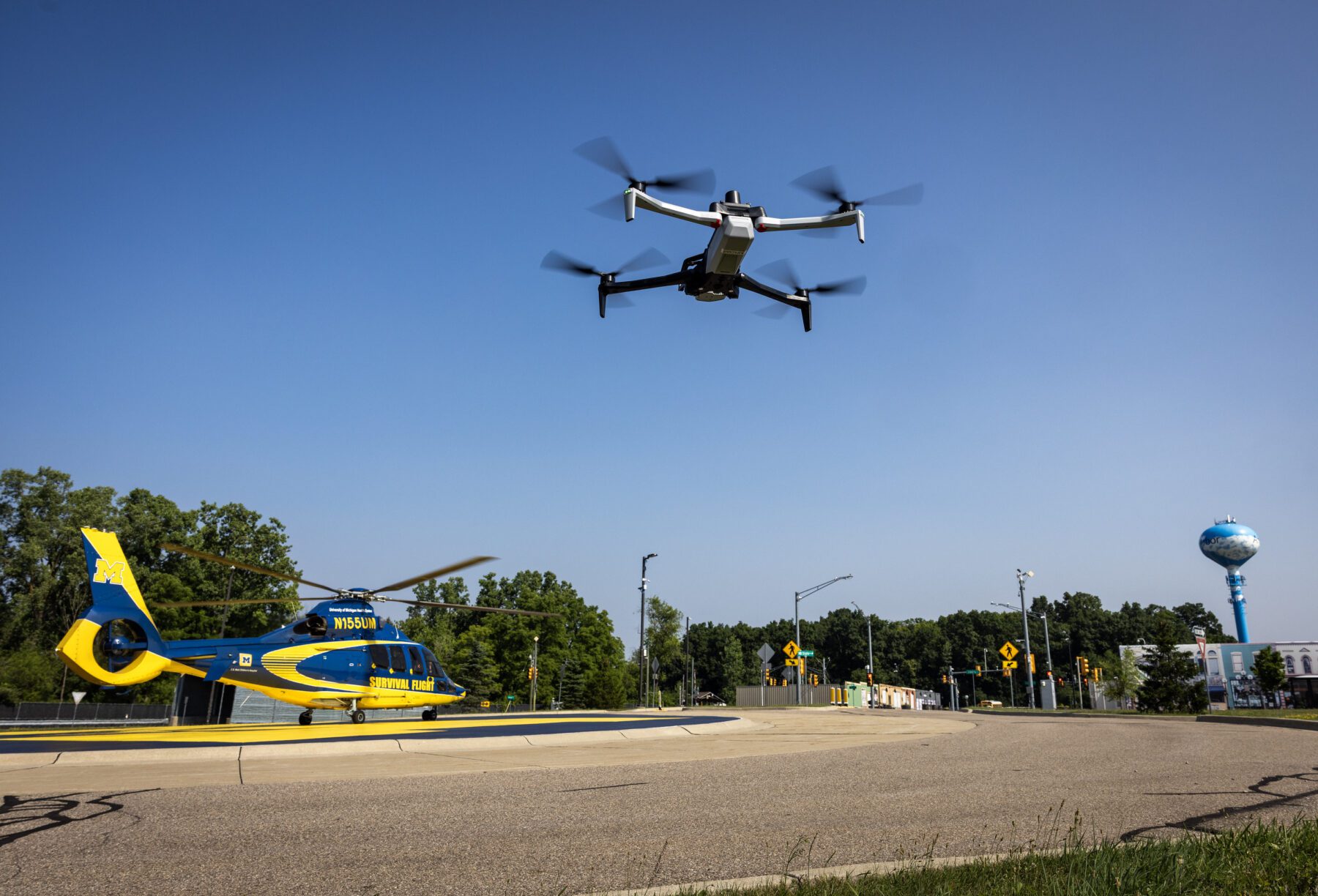
New Memorandum of Agreement (MOA) strengthens regional collaboration to advance unmanned air systems and the low-altitude economy
ANN ARBOR—M-air, an initiative launched by Mcity at the University of Michigan, welcomed nine new members to the public-private research partnership to accelerate the development of the low-altitude economy, which is focused on emerging commercial activities such as drone delivery, urban air mobility and agricultural services operating in the airspace below 3,000 feet.
The organizations were drawn to Mcity’s established leadership, facilities and expertise in AV research and testing, and M-air’s growing expertise in air mobility and UAS. Of the new members, ResilienX is an M-air founding member and brings significant open data integration capabilities needed to make M-air’s vision a reality.
“This new group of companies, government agencies and nonprofit organizations are investing a combination of cash and in-kind services to join Mcity to advance the state-of-the-art for autonomous vehicles and drones,” said Mcity Managing Director Greg McGuire. “Mcity has morphed into a bigger ‘makerspace for mobility.’ We have dozens of faculty and hundreds of students working on advanced mobility, which now includes M-air and its low-altitude airspace between Ann Arbor and Detroit.”
Agreement with ARI expands Mcity’s reach
This expansion is also part of the State of Michigan’s broader Advanced Air Mobility Initiative, which includes key programs such as MICH-AIR in Battle Creek, and the Advanced Aerial Innovation Region (AAIR) based at Michigan Central in Detroit.
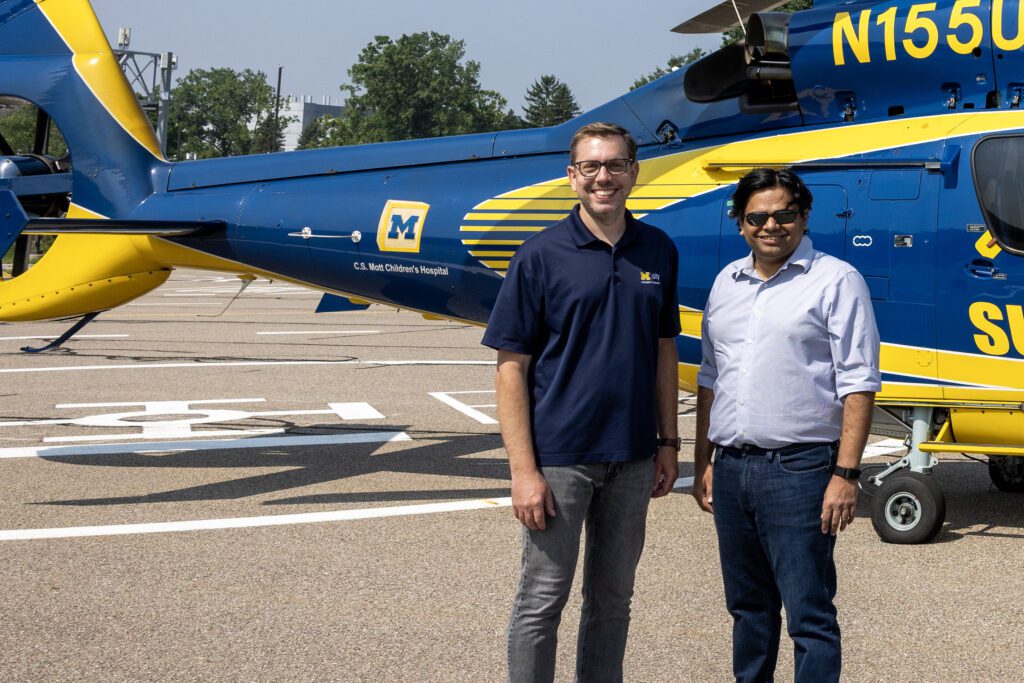
Greg McGuire, managing director of Mcity and M-air, left, with Venkat Viswanathan, director of M-air and associate professor of Aerospace Engineering at the University of Michigan, are leading U-M’s program to advance air mobility and speed the development of the low-altitude economy. (Photo Credit: Marcin Szczepanski, U-M College of Engineering)
At the same time, a new memorandum of agreement between M-air and Bloomington, Indiana-based Applied Research Institute will tap into M-air’s capabilities to advance applied UAS research, strengthen industry collaboration, and support the responsible growth of the low-altitude economy. Through the agreement, ARI and M-air will work together to connect regional assets, technical expertise, and industry partners around emerging opportunities in unmanned and autonomous systems. Indiana startup Pierce Aerospace has also joined M-air, bringing industry-leading expertise in remote identification across the ecosystem.
Our strategic alliance with Indiana’s UAS capabilities catalyzes M-air’s leadership, transforming bold research into validated real-world applications that serve as the backbone for the emerging low altitude economy. Our partnership creates a multi-state ecosystem for pioneering autonomous drone solutions across medical, agricultural, and industrial sectors.
Venkat Viswanathan, director of M-air and associate professor of Aerospace Engineering at U-M.
M-air is working to advance the responsible use of UAS, as well as the associated physical and digital infrastructure needed to safely operate these systems and integrate them into the national airspace.
The new MOA positions M-air as an additional academic and applied research partner for ARI as the organizations work to accelerate FAA-aligned UAS innovation. M-air is expected to bolster ARI’s applied research activities, support partner institutions, and help advance technical work related to safe, scalable, and responsible integration of unmanned systems into the National Airspace System.
MOA adds to ARI’s capabilities
As outlined in the MOA, ARI will work with M-air to strengthen applied UAS research capabilities, expand secure data collection and analytics, and support FAA-aligned challenge areas such as electric vertical takeoff and landing aircraft certification, low-altitude operational environment predictability, safety, and efficiency. The collaboration will help create new opportunities for industry, academia, and public-sector partners working to advance unmanned and autonomous systems across the region.
“ARI is focused on strengthening the Midwest’s role in advancing emerging technology ecosystems that support national and economic security,” said ARI CEO Andrew Kossack. “This MOA reflects the kind of regional collaboration needed to ensure next-generation unmanned and autonomous systems are built, tested, and scaled here in the heartland, across real-world environments. We’re excited to work alongside M-air as the connective tissue supporting a stronger drone ecosystem across the Midwest.”
M-air is the latest mobility initiative at the university, which has deep expertise in ground and air mobility. M-air, as part of Mcity, is part of the U-M Transportation Research Institute and the U-M College of Engineering. Other mobility-related engineering programs include the Center for Connected and Automated Transportation, a regional university transportation center funded by the U.S. Department of Transportation; the U-M Electric Vehicle Center; and the U-M Robotics Department.
With the new members, Mcity represents a diverse ecosystem of organizations working to advance mobility on the ground and in the air:
- AG3 Labs*
- Airspace Link*
- Capoom
- Deloitte
- General Motors
- General Robotics*
- Humanetics
- imec*
- Isuzu
- Michigan National Guard*
- MITRE
- Noblis
- Parallel Domain
- Pierce Aerospace*
- Robosense
- SAE International*
- State Farm
- SICK
- Subaru
- Toyota
- Verizon
- VI-grade
- Wayne County Airport Authority*
* Indicates new member