blueflite joins Mcity, wins state grant to pioneer autonomous organ transport in Michigan
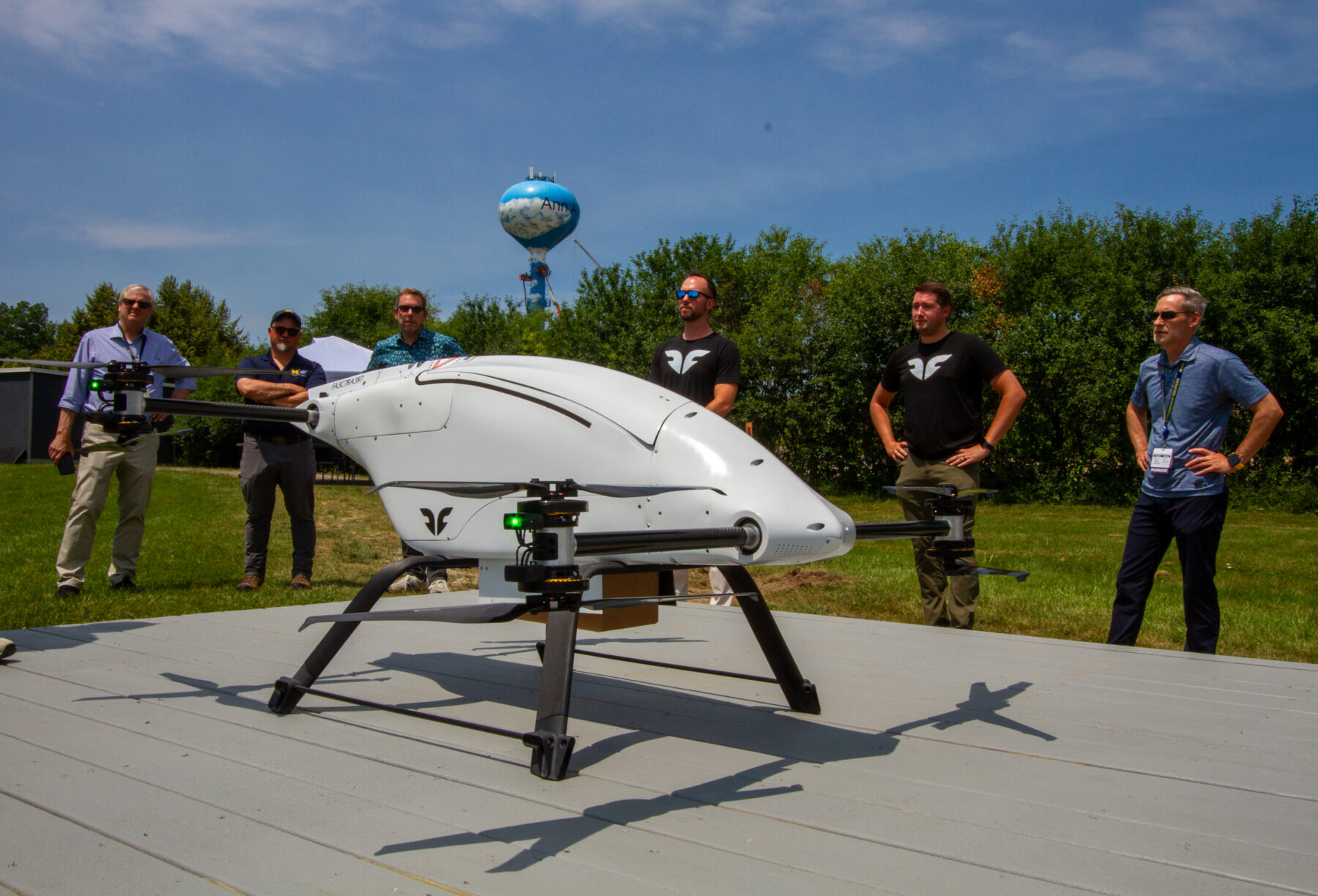
M-air, the University of Michigan’s advanced air mobility initiative, is working with blueflite and Michigan Medicine on a pilot program to show how autonomous aircraft can expedite time-critical organ transplant.
Funding for the project came from the Office of Future Mobility and Electrification, through the Michigan Mobility Funding Platform (MMFP), and was awarded to blueflite as the company also became a founding member of M-air, an expansion of U-M’s Mcity public-private advanced mobility partnership.
The pilot program is intended to demonstrate how autonomous aircraft could help hospitals overcome one of medicine’s most time-sensitive logistics challenges: transporting a donated organ to a transplant patient when every second counts.
Transferring organs between medical facilities often requires a mix of ground transportation, helicopters, and complex networks, all of which can be stymied by traffic, availability, and travel distance.
“M-air is building the enabling structure for blueflite and Michigan Medicine to operate, with funding from the Michigan Department of Transportation,” said Greg McGuire, managing director of Mcity, part of the University of Michigan Transportation Research Institute (UMTRI) at the U-M College of Engineering. “We’ll end up with an infrastructure blueprint MDOT can duplicate in other locations to support organ transfer across the state of Michigan.”
Founded in 2018, blueflite joins a growing list of air mobility companies partnering with M-air, including AG3 Labs, Airspace Link, the Michigan National Guard, Pierce Aerospace, and the Wayne County Airport Authority. Brighton, Michigan-based blueflite offers a drone-based logistics platform for fast, cost-effective deliveries using hardware designed and assembled in the United States.
The Federal Aviation Administration (FAA) requires drone pilots to operate with visual line of sight (VLOS), meaning they must be able to see the drone they are flying without aids such as corrective lenses. The pilot project with Michigan Medicine will deploy blueflite’s modular tiltrotor uncrewed aircraft system to support rapid, reliable transportation between medical facilities using BVLOS capabilities. The effort is designed to establish a scalable framework for medical drone delivery using Michigan’s advanced air mobility infrastructure across longer distances.
Michigan Medicine will serve as the clinical partner and transplant recipient site, supporting workflow integration and operational coordination. M-air will support airspace integration and BVLOS operations, helping connect the technology with the infrastructure and procedures needed for real-world deployment. The project will use the Mcity Test Facility as an environment for initial testing and validation.
“Whether it’s an organ for transplant to an academic medical center or critical blood components urgently needed at a rural site, time is of the essence. Minutes lost to traffic or logistical bottlenecks directly impact organ viability and patient outcomes. Partnering with Mcity and blueflite allows Michigan Medicine to build and validate an airspace delivery pipeline that could improve care delivery in the future,” said Dr. Florian Schmitzberger, Clinical Assistant Professor of Emergency Medicine at the University of Michigan Medical School.
The pilot project will evaluate how autonomous aviation can integrate into the broader transplant logistics system, including hospital workflows, regulatory requirements, safety procedures, and coordinate with existing transportation resources such as dispatch and first responders.
blueflite plans to conduct at least 20 end-to-end demonstration missions to measure flight and delivery times, mission reliability, system performance, safety, and payload monitoring. The team is targeting at least a 30% reduction in last-mile organ transport time compared with historical ground transportation benchmarks, along with a mission completion reliability rate of 95% or greater.
Protecting the medical payload will be an important part of the evaluation. The project will capture continuous temperature data, vibration and shock exposure, and time-stamped chain-of-custody information, alongside aircraft flight logs and hospital dispatch records.
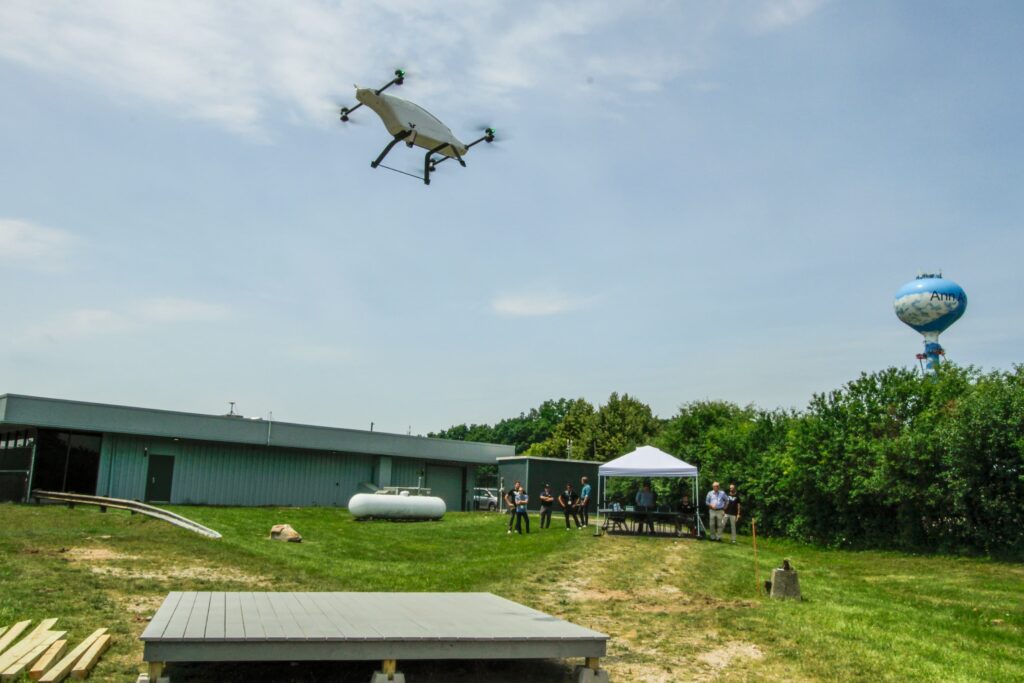
Credit: Calvin Tuttle/U-M Transportation Research Institute
“Joining Mcity gives blueflite the opportunity to work within one of Michigan’s strongest mobility ecosystems and bring together the technology, infrastructure, clinical expertise and regulatory coordination needed to make autonomous medical logistics a reality. This grant allows us to continue moving beyond demonstrating what the aircraft can do and continue validating how the entire system can operate in a real-world healthcare environment. Our goal is to prove a safe, reliable and scalable model for transporting time-critical medical payloads, that can ultimately be replicated across Michigan and beyond,” said Tyler Bruder, Business Development Lead at blueflite.
The final phase will evaluate operational and economic performance and develop recommendations for potential expansion throughout the state. The deployment is planned around the Mcity and Michigan Medicine facilities, creating a real-world environment to evaluate how autonomous aviation could complement traditional medical transportation.
Similar operations could eventually support the movement of blood samples, tissue, laboratory samples, and other time-sensitive medical supplies between hospitals and healthcare facilities across Michigan, especially in rural areas where response times are much longer.