Mcity evolves to become a “Makerspace for Mobility”
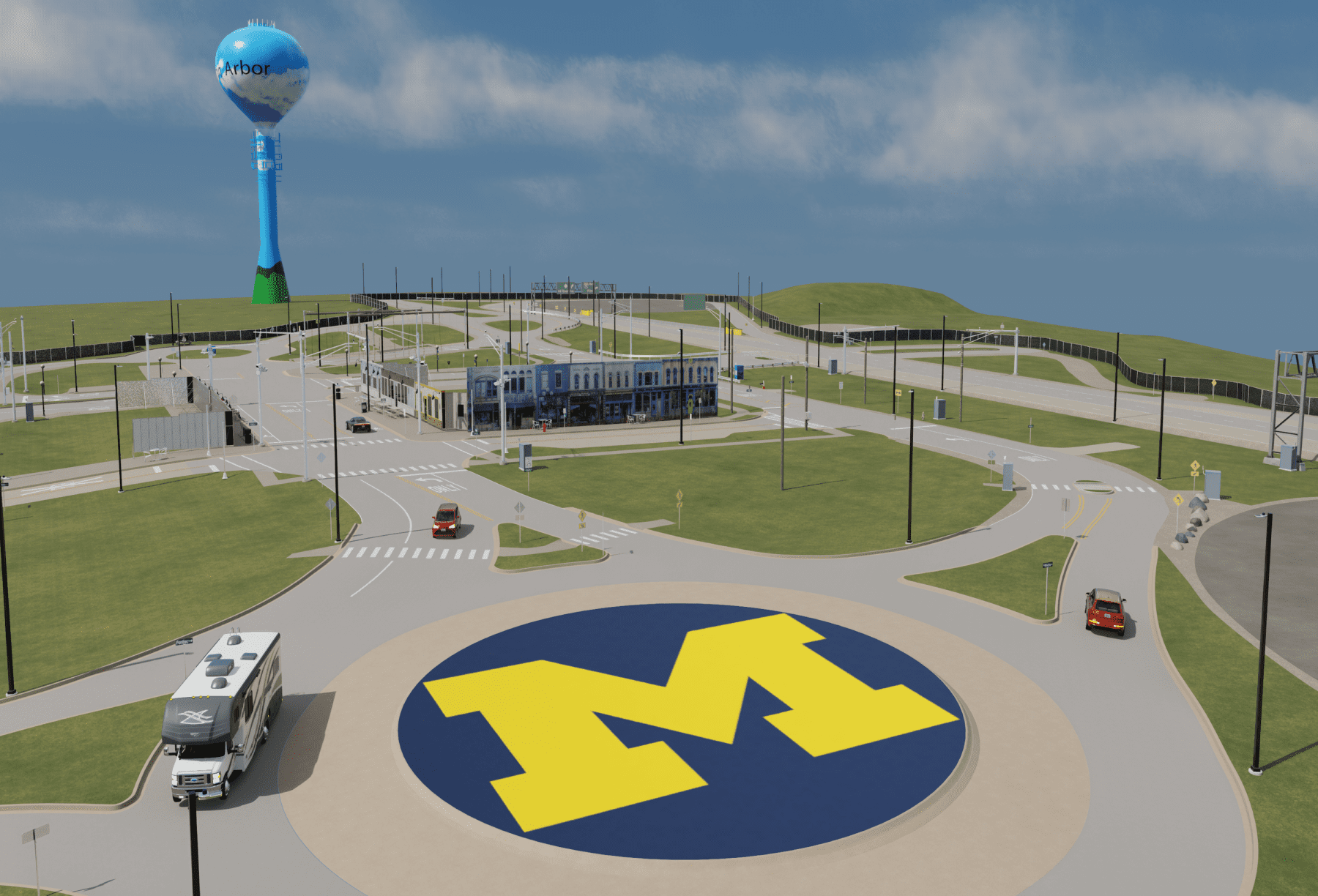
When Mcity opened its doors a decade ago, its goal as an R&D center and private-public partnership was to imagine a new world of mobility that would dramatically improve transportation safety, sustainability, equity, and accessibility for all. Its focus was on connected and automated vehicles, including operating a purpose-built test facility for evaluating these vehicles and technologies in a safe, controlled, real-world environment and collaborating with industry and government. It also funded academic research in areas of shared need.
The transportation community took notice. In the last five years, the center attracted $50 million in R&D funding from the U.S. Department of Transportation, the National Science Foundation and the Defense Advanced Research Projects Agency, better known as DARPA. Mcity developed digital infrastructure that enables remote use of the Mcity Test Facility, and created a digital twin of the track that allows testing and evaluation using simulation from anywhere in the world. These innovations are available for free, for anyone to use in their own research or commercial development.
Today, Mcity is publicly recognized as a leader in the AV testing field, supported by a university with a world-class engineering college and a 200-year track record of making big things happen.
In October 2024, after two years of technical upgrades, the center launched remote use capabilities that enable researchers across the country to evaluate AVs and software inside the Mcity Test Facility without leaving their own labs. With support from the National Science Foundation (NSF), it developed new digital infrastructure that pairs with the physical test track to enable this remote use.
Two months later, in December 2024, the center made the first open-source digital twin for mobility systems testing available to the public for free. The digital twin of the Mcity Test Facility, also developed with funding from NSF, is a virtual representation of the physical test environment that also exchanges data with that environment, enabling simulation and testing.
In March 2025, Mcity enhanced the digital twin by integrating NVIDIA Omniverse to close the divide between simulated and real-world testing conditions, also known as the “sim-to-real gap.”
Along the way, something unexpected happened. Startups, along with established companies and government agencies, began to imagine novel testing and commercialization use cases for the facility in ways no one had anticipated. These use cases included smart city applications, environmental and urban infrastructure innovations, and the recently announced M-air private-public partnership, devoted to drone and advanced air mobility initiatives.
The center’s primary focus remains autonomous vehicle innovation and validation. At the same time, Mcity has evolved into a “mobility makerspace” that supports startup companies in their R&D, testing, and technology commercialization.
“Mcity provides adjacency to talent and original research,” said Managing Director Greg McGuire. “This helps attract these companies and encourages them to set up shop and work in Michigan. Mcity lowers the barrier to market entry for startups by providing resources they couldn’t otherwise afford.
Note: Mcity has launched an ongoing series spotlighting startup companies we work with, which will be shared here on our website, as well as through LinkedIn posts by Mcity Managing Director Greg McGuire.